Papercraft does not have to remain paper in its original form. Through coating, covering, layering and finishing, paper structures can be adapted for different purposes, offering lightweight, customisable and practical alternatives for installations, displays, events and sculptures where traditional materials may be unnecessarily heavy or restrictive.
Paper is usually thought of as a finished material. You buy it, draw on it, fold it, cut it and eventually put it away. But for a paper artist, the sheet is often only the beginning.
A carefully constructed paper form can be coated, covered, laminated, sealed or finished with another material to change the way it behaves. What begins as paper can become a surface, an object, a sculpture, a prop, a display element or even a functional piece designed for a particular environment. The interesting part is not simply making paper stronger. It is the possibility of separating the process of making from the final material experience.
This opens up an entirely different way of thinking about papercraft.
Traditional sculpture often begins with the final material. Stone is carved because it already has the strength and permanence required of a sculpture. Wood is cut and shaped because it can hold a structure. Metal is welded because it can create large, rigid forms. Fibreglass, resin and other composite materials are used when durability and complex shapes are required.
Paper can approach the same problem from the opposite direction.
Instead of asking what shape a material can naturally hold, an artist can first create the shape and then decide what the finished surface needs to do.
A paper structure might need to be rigid enough to stand independently. Another might need a smooth surface for painting. One installation may need protection from handling, while another may need a particular texture or finish. A temporary event piece may only need to survive for a few days, while a display intended for a longer period may require considerably more protection. Coating and covering techniques make it possible to respond to these different requirements without abandoning the flexibility of paper as the starting material.
This is where paper becomes particularly interesting as a sculptural medium.
A traditional material can sometimes make the process expensive, heavy or difficult before the sculpture has even taken shape. A large wooden or metal structure may require specialised equipment, transportation and substantial physical effort. Stone demands the removal of material to reveal the form within it. Certain moulded materials require extensive tooling and preparation before production can begin.
Paper works differently. Complex forms can be constructed from relatively light sheets, assembled in sections and transported with considerably less weight. Repetition is also possible. A single carefully designed element can be produced again and again to create a much larger structure.
Once the form exists, the surface can be treated according to its purpose.
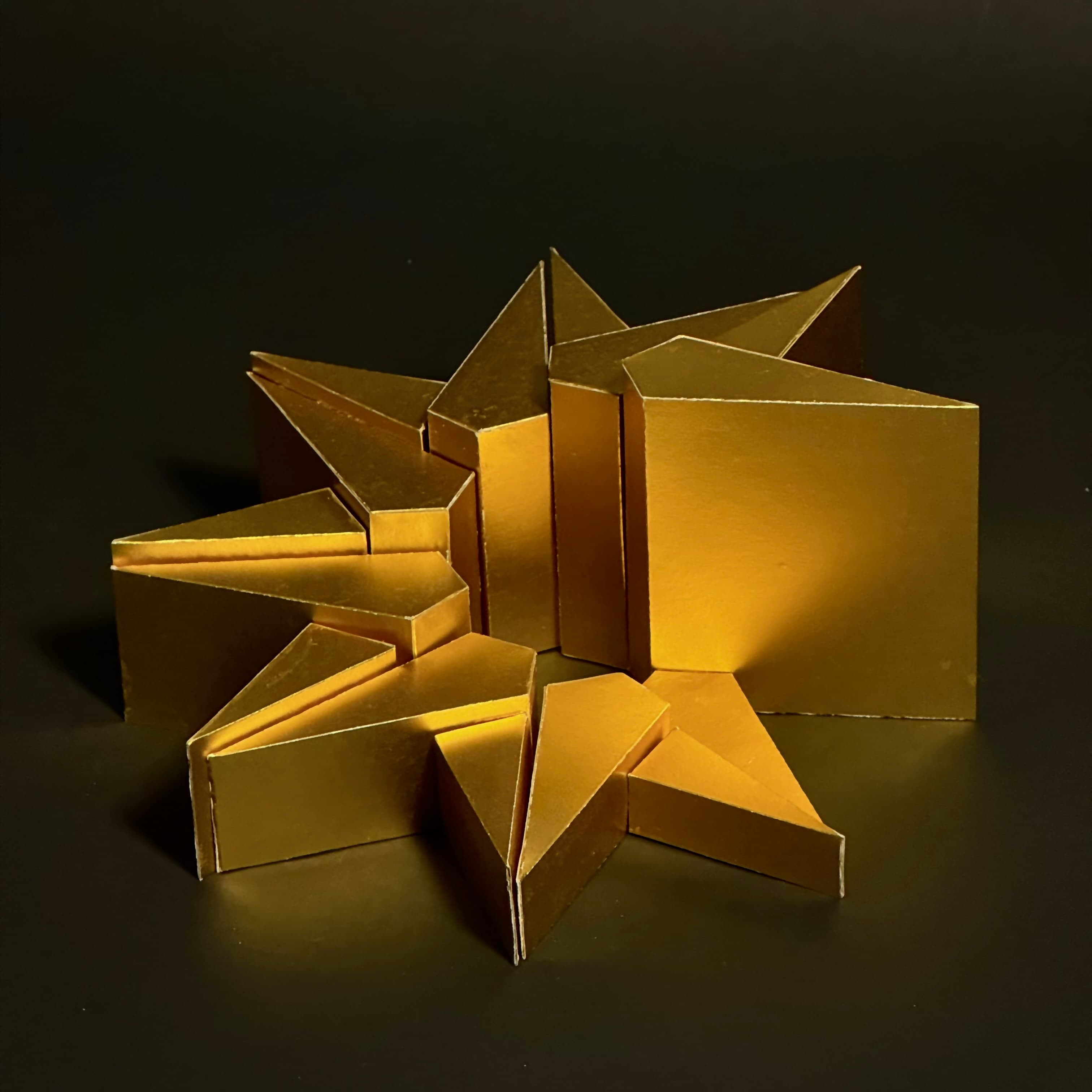
A coating can change the appearance of a sculpture completely. It can create a matte surface, a glossy finish, a textured exterior or a surface that resembles another material. A paper construction can be painted to look like wood, stone, ceramic or metal while retaining the lightweight structure underneath. A layer added over the paper can conceal the original construction or deliberately leave parts of the paper visible, allowing the viewer to see both the illusion and the craftsmanship.
This creates an interesting relationship between what something is and what it appears to be.
A sculpture does not necessarily have to be made from stone to look like stone. A decorative architectural element does not necessarily have to be carved from wood. A large event prop does not necessarily need to be manufactured from a heavy industrial material simply because it needs to appear substantial.
Sometimes, the better solution is to construct the form from something light and transform the surface afterwards.
This becomes especially useful for temporary environments.
Events, exhibitions, weddings, retail displays, stage sets and promotional installations often need impressive physical structures that exist for a limited period of time. Building every temporary object using permanent, heavy or highly resource intensive techniques can be unnecessary. A lightweight paper based structure can be fabricated, transported, installed and eventually dismantled with a very different logistical footprint.
The advantage is not simply that it is cheaper or lighter. It is that the material can be matched to the lifespan of the idea.
If something is required for three days, it does not necessarily need to be engineered like something expected to remain outdoors for twenty years. If a sculpture is designed for an indoor exhibition, its requirements are different from those of a public installation exposed to weather. If a retail display is intended to change every few months, flexibility and ease of replacement can matter more than extreme permanence.
Papercraft allows these questions to be considered much earlier in the design process.
It also changes what can be achieved visually.
Because paper is relatively easy to cut, fold and layer, intricate surfaces can be built without having to carve every detail from a solid block of material. Repeated patterns, scales, feathers, petals, architectural details and geometric structures can all be constructed from individual pieces. When these forms are subsequently coated or finished, the result can have the visual presence of a much heavier sculpture while remaining fundamentally lightweight.
This becomes particularly powerful at larger scales.
A life sized figure, a giant animal, a sculptural tree or an elaborate architectural installation can become difficult to handle when made from conventional solid materials. With paper, the internal structure can remain comparatively light while the exterior provides the desired appearance and finish. The result is a sculpture that can occupy considerable physical space without carrying the same material weight.
For installations, this matters enormously.
A lighter sculpture can be easier to move through a building, easier to position inside an existing space and easier to suspend from a suitable structure. Transportation can become simpler. Installation teams may be able to work with larger pieces without relying on the same equipment required for heavier construction. In spaces where load, access or installation time are important constraints, reducing weight can be a design advantage rather than merely a convenience.
There is another advantage that is less technical and perhaps more important.
Paper allows the artist to think in terms of construction rather than subtraction.
When carving stone, the material is removed. When shaping a block of wood, the artist works within the limits of what is already there. With paper, form can be built outward. A surface can be layered. A structure can be hollow. A section can be replaced. An individual component can be redesigned without necessarily rebuilding the entire object.
This makes experimentation considerably more accessible.
The same philosophy can extend beyond sculpture. Paper based forms can become display structures, decorative architectural elements, themed environments, exhibition pieces, product displays, props, costumes and event installations. Once the underlying form is treated as a constructed object rather than merely a craft project, the possibilities become much wider.
The finishing process then becomes part of the design rather than an afterthought.
A protective coating can be chosen for durability. A surface treatment can create a specific visual identity. A covering can provide texture. Paint can transform the character of the object. Fabric, foil, printed surfaces or other finishes can be introduced where appropriate. The underlying paper construction becomes a kind of structural language that can support many different final expressions.
This is perhaps the most compelling argument for looking at papercraft differently.
Paper does not necessarily have to compete with stone, wood, metal or other traditional sculptural materials on their own terms. It can offer a different route to the same visual or spatial objective.
The question is not always which material is strongest.
Sometimes the better question is which material allows the idea to be made most intelligently.
For a permanent outdoor monument, traditional materials may still be the appropriate choice. For a temporary installation, an elaborate event environment, a lightweight suspended sculpture or a highly detailed decorative form, however, a paper based construction can offer advantages that conventional materials cannot easily provide.
And with the right finishing technique, the viewer may never even realise that paper is underneath.
That is what makes coated and finished papercraft so interesting. The paper does not disappear because it has failed. It disappears because it has successfully become something else.
A simple sheet can become the foundation for a sculpture that looks solid, substantial and permanent. A collection of folded pieces can become an architectural surface. A lightweight construction can take on the appearance of a completely different material.
The future of papercraft may therefore have less to do with keeping paper recognisable and more to do with understanding how far it can be transformed.
Paper can be the structure.
The coating can become the skin.
And together, they can become something that neither material could have achieved on its own.
Written by Anuj Tomar